
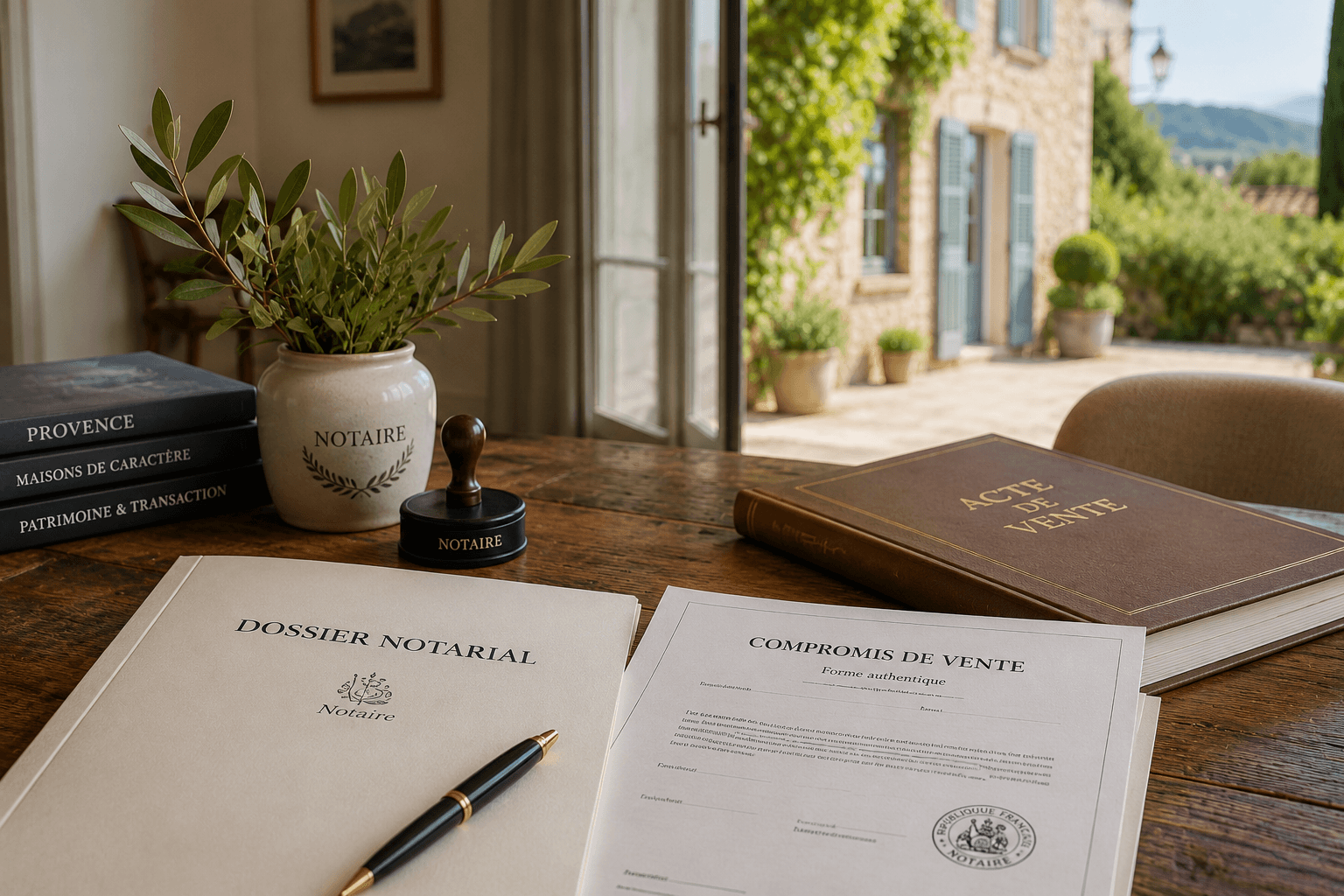
Buying property in France follows a structured legal rhythm. For an international buyer, this can feel reassuring, but only when each stage is understood before commitments are made.
The French property purchase process is not simply a sequence of signatures. It is a framework designed to clarify the property, the buyer’s position, the seller’s obligations and the legal conditions attached to the sale. In Provence, where homes may involve character architecture, land, renovation potential, co-ownership rules or protected settings, this preparation matters as much as the choice of the property itself.
For a broader view of the lifestyle, location and ownership decisions that sit around the transaction, our article on buying property in Provence can be read alongside this more practical overview.
A process built around legal certainty
In France, the notaire plays a central role in the sale. The notaire is a public officer who secures the transaction, verifies legal information, prepares or supervises key documents and ensures the sale can be published with the land registry.
This does not mean the buyer should remain passive. The notaire secures the legal framework of the transaction, but the buyer must still clarify their personal, financial and ownership position before the purchase becomes binding. This is especially important for buyers acquiring from abroad, buyers purchasing as a couple or family, and buyers considering a long-term holding structure.
If the property is being acquired through a family structure, for succession planning or for shared ownership, our article on buying property via an SCI in France is a useful next reading step before the preliminary contract is signed.
Before the offer
The first stage is not legal. It is strategic.
Before making an offer, the buyer should understand the property beyond its presentation. In Provence, this may include access, land boundaries, easements, renovation permissions, energy performance, septic systems, co-ownership documents, local planning rules or heritage constraints.
A strong offer should be based on more than price. It should also reflect the intended use of the property, whether as a second home, primary residence, rental asset, family estate or long-term patrimonial purchase. Financing should also be clear at this stage, especially when the purchase depends on a mortgage, foreign currency transfers or the sale of another asset.
For premium properties, it is often preferable to clarify these points early rather than renegotiate them under pressure once the seller has accepted the offer.
From accepted offer to preliminary contract
Once the offer is accepted, the transaction usually moves towards a preliminary contract. This may take the form of a compromis de vente or a promesse de vente, depending on the structure of the sale.
This document is far more than a formality. It identifies the parties, describes the property, states the price, sets the expected completion date and records the conditions under which the sale may proceed. These may include financing conditions, planning matters, title checks, pre-emption rights or other points specific to the property.
The preliminary contract is also where the buyer should ensure that the essential assumptions behind the purchase are properly reflected. If financing is needed, the loan condition must be coherent. If renovation is central to the project, relevant planning and technical points should be reviewed before signing. If the buyer cannot travel easily, the signature process and any power of attorney should be anticipated.
The cooling-off period
For a non-professional buyer purchasing residential property, French law provides a 10-day withdrawal period after notification of the preliminary contract. During this period, the buyer may withdraw without having to justify the decision.
This protection should not be misunderstood. It is not a substitute for proper preparation. Once the withdrawal period has expired and the conditions in the preliminary contract are satisfied, the buyer’s commitment becomes significantly stronger.
In practice, the cooling-off period gives time to reconsider. It should not be the first moment at which the buyer truly studies the file.
The notaire’s checks
After the preliminary contract, the notaire carries out a series of checks before the final deed can be signed. These checks may cover the seller’s title, mortgage registrations, easements, planning rules, pre-emption rights, property diagnostics and other legal or administrative elements.
For non-resident buyers, additional attention may be required around identity documents, marital status, matrimonial regime, source of funds, bank transfers and the tax consequences of ownership. The property is located in France, so French real estate law governs the transaction, but the buyer’s personal situation may still influence the most suitable ownership route.
The notarial process is therefore not only administrative. It is where the legal reality of the property is aligned with the transaction the buyer believes they are entering into.
The final deed and transfer of ownership
The final signature takes place through the acte authentique de vente. This is the authentic deed of sale signed before the notaire.
At this stage, the balance of the price and acquisition costs must be available. Once the deed is signed, ownership transfers to the buyer, the seller is paid and the keys are usually handed over. The notaire then completes the publication formalities with the land registry.
The buyer will not usually receive the final registered title immediately. The notaire provides the required confirmations, and the formal title documentation follows once publication has been completed.
What Provence buyers should watch closely
The legal process is broadly the same across France, but the points requiring attention vary according to the property.
A village house may raise questions about party walls, access, co-ownership or renovation constraints. A country estate may require closer review of land boundaries, agricultural status, water access, septic compliance, outbuildings or rights of way. A villa near the coast or in a protected environment may involve planning sensitivities. A property intended for seasonal rental may require a separate review of local rules and practical management.
This is where a Provence purchase should be approached with both legal discipline and local understanding. The process secures the transaction, but the quality of the decision depends on the questions asked before signing.
Preparing as an international buyer
An international buyer should prepare the practical file early. This usually includes identity documents, proof of address, proof of funds, banking details, financing evidence, marital information and any documents required for a power of attorney.
Currency transfers should also be timed carefully. Acquisition costs, deposit payments and the final balance do not always fall neatly into the buyer’s home banking schedule. Delays in international transfers can create unnecessary pressure near completion.
It is also sensible to take advice on ownership structure, inheritance considerations, tax residence and future resale before the acquisition is finalised. These points do not need to complicate the purchase, but they should not be discovered after completion.
Planning a property purchase in Provence?
A well-managed purchase in France is not about rushing from offer to signature. It is about choosing the right property, structuring the acquisition carefully and allowing the legal process to do its work.
Discover our Provence properties | Contact us
Sources
Notaires de France, The promise to sell and the sales agreement
Service-Public.fr, Mandatory property diagnostics for the sale of a dwelling
Notaires de France, Signature of preliminary contracts and authentic deeds of sale
This article is provided for general guidance only. The French property purchase process, notarial practice, acquisition costs, planning rules, tax treatment and conditions applicable to non-resident buyers may change or vary according to the property and the buyer’s personal situation. Buyers should verify their position with a notaire, qualified legal and tax professionals, and the relevant authorities before making a decision.
