Checking property eligibility in Mauritius should be one of the first steps for any international buyer. Although the island offers a clear framework for foreign property ownership, not every property can be purchased by a non-citizen, and not every eligible acquisition provides the same residence outcome.
This verification should take place before the buyer becomes emotionally committed to a property. A villa may appear ideal, an apartment may be well located and a development may feel premium and secure. None of these qualities answers the essential legal question: can this specific property be acquired by this particular buyer under an authorised route?
For a broader view of the acquisition process, our article on buying property in Mauritius as a foreign investor explains the main legal routes, costs and timing points. This article focuses on a narrower but essential stage of the process: confirming the property’s eligibility, the applicable approval route and any residence implications before moving forward.
Why eligibility comes before negotiation
Eligibility is not just an administrative detail. It determines whether the buyer can proceed, which approval route applies, whether residence may be available, and what documents must support the transaction.
A non-citizen cannot simply buy any residential property on the open market. The acquisition must fall within an authorised framework or a specific legal route. If this point is left too late, the buyer may waste time on a property that cannot be acquired, or assume residence rights that the property does not support.
This check should therefore happen before signing a reservation agreement, paying a deposit or building the purchase structure around an unverified assumption.
Buyer eligibility and property eligibility are different
A buyer may be financially ready and still be looking at a property that is not eligible for acquisition by a non-citizen.
The first point is buyer eligibility. This concerns the person or structure acquiring the property. The second is property eligibility. This concerns the asset itself, its legal status and the route under which it is being sold.
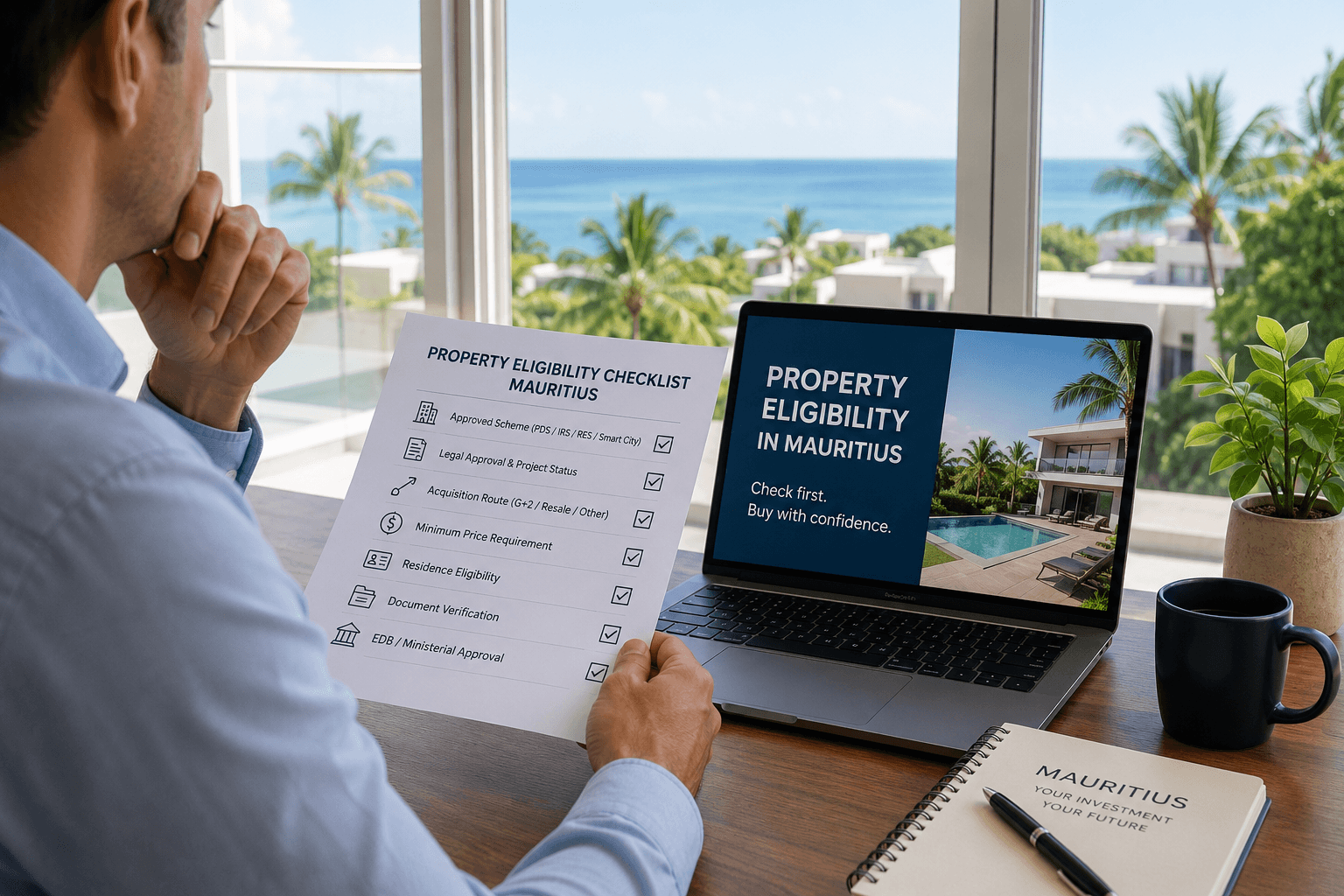
In practice, the buyer should confirm whether the property is:
a unit within an approved PDS, IRS, RES or Smart City project;
a qualifying apartment in a Ground plus two development;
a resale of a property originally acquired under an authorised route;
another type of property requiring a specific approval or legal review.
The wording used in marketing material is not enough. The file should clearly show the legal basis on which the property can be sold to a non-citizen.
Approved schemes should be checked at project level
When buying within a development, eligibility starts with the project itself.
The buyer should confirm that the development has the relevant approval for the scheme being presented. This is especially important for off-plan property, resort-style residences and mixed-use environments where the commercial material may focus on architecture, lifestyle or services before the legal framework.
A premium brochure is not proof of eligibility. The key question is whether the specific unit being sold falls within the approved parameters of the project.
For wider market context, our article on the Mauritius property market for foreign investors explains how the premium segment is structured. Eligibility, however, still needs to be verified property by property.
Apartments need a separate review
Apartments are one of the areas where buyers can easily confuse acquisition eligibility with residence eligibility.
A foreign buyer may acquire an apartment outside an approved residential scheme when it is located in a condominium development of at least two floors above ground floor and meets the required minimum price. Under the G+2 route, public EDB information refers to a minimum acquisition price of 6 million rupees or its equivalent in another accepted currency.
Residence is a separate point. The same EDB framework refers to a residence permit being available when the acquisition reaches at least 375,000 USD or the equivalent in accepted currencies.
This distinction matters. An apartment may be eligible for purchase without automatically supporting the buyer’s residence plans. Before committing, the buyer should therefore confirm both the acquisition route and the residence implications.
Residence should never be assumed
Many international buyers connect the purchase to a longer-term plan: seasonal living, retirement, family relocation or a future base in Mauritius. That is understandable, but residence should never be treated as a general benefit attached to all property purchases.
For qualifying acquisitions under approved routes, residence may be available when the required threshold and conditions are met. The permit is generally linked to continued ownership of the qualifying property.
For lifestyle planning beyond the acquisition itself, our article on living in Mauritius as a foreigner explores how property choice connects with daily life, location and long-term use.
Resale properties still require checks
A resale property should not be treated as automatically eligible simply because it sits within a known development.
The buyer should confirm how the property was first acquired, whether the resale remains within the applicable conditions, and whether transfer to a new non-citizen buyer is allowed. The original approval, title deed, seller documentation and resale process should all be reviewed before the buyer commits.
This is particularly important when the property is held through a company, when the ownership history is complex, or when the buyer is relying on the purchase to support residence.
What to confirm before signing
Before moving ahead, the buyer should request a clear eligibility file. Depending on the property, this may include the title deed, project approval, scheme documentation, unit details, resale history, sale agreement, land status and any documents needed for EDB or ministerial approval.
The objective is not to turn the buyer into a legal specialist. It is to make sure the property, price, buyer profile and intended use all point in the same direction.
A well-checked property allows the rest of the purchase to become clearer: financing, timing, residence planning, family use, rental intentions and long-term ownership.
Confirming eligibility before buying in Mauritius
Before committing to a property in Mauritius, foreign buyers should confirm the acquisition route, approval process and residence implications with the right professional support. Eligibility is not a formality. It is the foundation of a secure and well-structured purchase.
Discover our properties | Contact us
Sources
This article is for general guidance only and does not constitute legal, tax, residence or investment advice. Property acquisition rules, approval procedures, thresholds and residence conditions in Mauritius may change. Buyers should verify the eligibility of any specific property with qualified legal advisers, the notary, the Economic Development Board and the relevant authorities before signing or transferring funds.
