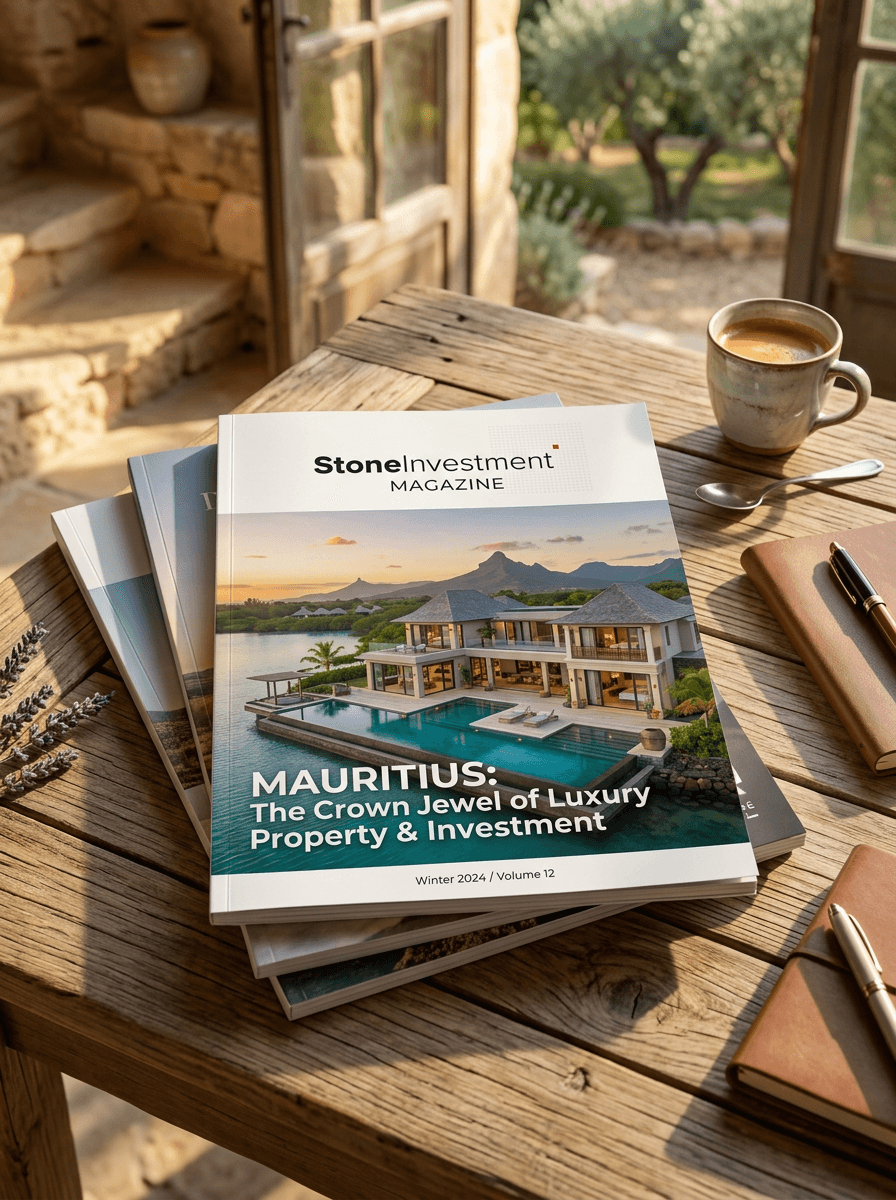
For many international buyers, property in Mauritius is not only a second-home decision. A qualifying acquisition can also provide a legal route to residence, allowing the owner to build a longer-term base on the island while retaining the property that supports the permit.
The headline figure is well known: USD 375,000. But that threshold only works when the property falls within an eligible route and the transaction satisfies the applicable conditions. It does not mean that any home worth USD 375,000 gives a foreign buyer residency, nor does a residence permit automatically make the owner tax resident in Mauritius.
For the wider ownership framework, our article on buying property in Mauritius as a foreign investor explains which properties non-citizens can acquire. Here, the focus is specifically on how residency through property works, who can benefit and what must remain true after the purchase.
How the USD 375,000 residency threshold works
Under the current immigration framework, a non-citizen can qualify for a residence permit through the acquisition of eligible Mauritian property for at least USD 375,000, or its equivalent in another hard convertible foreign currency.
The exchange rate used to establish the USD equivalent is the selling rate in force when the title deed is signed. This can matter where the property price is agreed in euros, sterling or another currency close to the threshold.
The amount alone is not enough. The property must belong to a recognised route. The standard property-based residence framework covers qualifying acquisitions under the Property Development Scheme, Smart City Scheme, Sustainable City Scheme, Invest Hotel Scheme and qualifying legacy IRS or RES developments, together with qualifying G+2 apartments.
A buyer should therefore verify eligibility before treating residency as part of the purchase. Our article on checking property eligibility before buying in Mauritius looks at that distinction in detail.
Residence is linked to the qualifying property
The principal feature of this route is that the residence right is connected to ownership.
For qualifying PDS and G+2 acquisitions, official guidance states that the residence permit remains valid for as long as the non-citizen continues to own the residential property. The same ownership logic underpins the wider property-acquisition residence framework.
This makes the permit different from an Occupation Permit or retirement permit, which rests on employment, business, professional or income conditions rather than a particular property.
It also means the exit strategy matters. A buyer who later sells the qualifying property should not assume that residence continues independently. If remaining in Mauritius is important after a sale, another qualifying property or immigration status may need to be arranged in advance.
The permit is therefore better understood as long-term and ownership-linked than as citizenship or unconditional permanent residence.
Which properties can support residency
The main qualifying routes give buyers different property formats, but the residence test should be checked separately from the right to purchase.
PDS can include villas, apartments and penthouses within approved residential developments. Smart City property sits within a broader mixed-use environment, while Sustainable City follows its own approved framework. Existing IRS and RES stock can remain relevant on qualifying resales.
The Invest Hotel Scheme can also support residence where the qualifying acquisition reaches the required threshold, although the asset remains part of a hotel structure and personal occupation is restricted under IHS rules.
G+2 provides a separate apartment route. A foreign buyer may acquire a qualifying apartment from MUR 6 million, but residence requires the higher and distinct USD 375,000 threshold. A G+2 apartment may therefore be legally purchasable without creating residence eligibility.
The property's legal status should be confirmed from the project and transaction documents rather than inferred from a brochure, price or location.
Joint purchases need their own threshold review
Property can be acquired jointly, but the USD 375,000 rule should not simply be divided between unrelated co-buyers who each expect an individual residence permit.
The Immigration Act provides for joint acquisition under recognised schemes where the person seeking residence contributes at least USD 375,000, or the relevant foreign-currency equivalent, to the purchase price.
This matters for friends, business partners or other co-investors considering one higher-value property together. The total property value does not establish residence eligibility for every purchaser.
Couples and family structures should also be reviewed according to how the property is acquired and who will be the main permit holder.
Dependants can accompany the main holder
A qualifying main holder can generally apply for residence for eligible dependants.
Current immigration guidance defines dependants of Residence Permit holders to include a spouse, qualifying parents and dependent unmarried children not over 24 years of age, including stepchildren and lawfully adopted children.
The dependent permit cannot run longer than the main holder's permit. Dependants also do not automatically receive the same right to work as the principal property owner. A dependant wishing to take employment must obtain the appropriate Work Permit or Occupation Permit where required.
The family can therefore live in Mauritius under the main holder's property-based status, but each family member's position should still be planned around study, work and longer-term circumstances.
The main property owner can work or invest
For the mainstream property-acquisition residence routes described above, the principal holder is exempt from the requirement to obtain a separate Work Permit or Occupation Permit to work or invest in Mauritius.
This can be an important practical advantage for internationally mobile owners. It allows the principal holder under the relevant property-acquisition routes to work or invest without qualifying separately as an investor, self-employed person or professional.
It does not remove sector-specific licences, professional registration or other regulatory requirements for a particular activity. Immigration permission and permission to conduct a regulated profession are separate questions.
Property residence is not the same as tax residence
One of the most important distinctions is between an immigration residence permit and tax residency.
Buying a qualifying property and obtaining a residence permit does not automatically make the owner tax resident in Mauritius. Tax residence is determined under the Income Tax Act by separate tests.
An individual can generally become Mauritian tax resident by being present in Mauritius for at least 183 days in an income year, or by being present during that income year and the two preceding income years for an aggregate of at least 270 days. Domicile can also be relevant under the statutory definition.
This matters for buyers dividing their time between several countries. A person may legally hold a Mauritian residence permit while remaining tax resident elsewhere, depending on physical presence, domicile, the other country's rules and any applicable double-tax treaty.
Property should therefore not be purchased on the assumption that residence automatically produces a particular tax outcome.
The residence application follows the property acquisition
The property and immigration steps are connected, but they are not the same transaction.
The buyer first needs a property that can legally be acquired by a non-citizen under the relevant route. The acquisition must then be completed in accordance with the applicable approval, funding and deed requirements. Once the qualifying property has been acquired and registered, the residence-permit application can follow with the required supporting documents.
Depending on the applicant and family composition, the immigration file may include identification documents, civil-status records, medical documentation and evidence of the qualifying property acquisition.
Buyers should also distinguish the residence threshold from the funding rules applying to the transaction. For covered approved schemes, our article on the 85% MUR rule for foreign buyers explains the separate currency and payment requirements that may affect the purchase.
A separate senior-living route exists
The standard USD 375,000 framework is not the only property-related residence route.
Mauritius also provides a dedicated PDS Senior Living route for qualifying non-citizens aged over 50. Under the current Immigration Act, a residence permit can be linked to the purchase or acquisition of residential property within an approved PDS Senior Living project where the purchase price exceeds USD 200,000, or its equivalent in another hard convertible foreign currency.
This specialised route follows different conditions from ordinary PDS property acquisition and should therefore be assessed separately, particularly where the proposed arrangement involves a life right, lease or another form of occupation rather than a conventional acquisition.
For a buyer comparing mainstream residential ownership with retirement-specific accommodation, the precise property and residence structure should be confirmed before committing.
What to confirm before relying on property for residence
Before making residency part of the purchase decision, the buyer should confirm:
that the specific property is legally open to non-citizen acquisition;
the exact scheme or acquisition route applying to the unit;
that the purchase price or individual contribution meets the residence threshold;
the currency conversion basis where the price is not expressed in USD;
who will be the principal residence-permit applicant;
which family members qualify as dependants;
whether any dependant intends to work in Mauritius;
how a future sale would affect continued residence.
These checks should happen before the buyer commits to a property on the assumption that it solves an immigration objective.
Building a residence plan around the right property
Residency through property investment in Mauritius can be a clear and durable route for foreign buyers, but only when the property, purchase structure and immigration objective align.
For most mainstream qualifying acquisitions, USD 375,000 remains the central residence threshold. The permit is tied to the qualifying property, eligible dependants can accompany the main holder, and the principal holder can work and invest without a separate Occupation or Work Permit.
What the property does not do is create citizenship, guarantee tax residence or turn every foreign-buyer acquisition into a residency route.
The strongest approach is therefore to decide early whether residence is a genuine objective, confirm the qualifying route before reserving the property and structure the purchase around both ownership and immigration requirements from the outset.
Discover our Mauritius properties | Contact us
Sources
Mauritius National Assembly - Finance (Miscellaneous Provisions) Act 2023
Residency Mauritius - Occupation Permit and Residence Permit Guidelines
Mauritius Revenue Authority - Foreign Income and Tax Residence
This article is provided for general guidance only and does not constitute legal, tax, immigration or investment advice. Residence eligibility, qualifying property routes, dependant status, work rights, tax residence rules and administrative procedures may change or depend on the property, applicant and transaction structure. Buyers should verify the current position with the Economic Development Board, Passport and Immigration Office, Mauritius Revenue Authority, their Mauritian notary and appropriately qualified professional advisers before committing to a purchase.
